AI Skills Are Creeping Into Accounting Job Descriptions. Here's What's Actually Being Asked.
Lorem ipsum dolor sit amet, consectetur adipiscing elit. Donec rhoncus neque sed nibh sagittis, fringilla porttitor ipsum tristique. Nulla interdum ex et nisi vehicula, id laoreet nisl ultricies. Phasellus vitae magna ac lacus dictum tincidunt. Sed iaculis metus nec viverra pulvinar. Etiam id nisi eu turpis mattis imperdiet ac ac tortor. Aliquam at ipsum dui. Etiam pharetra consequat massa. Aenean nec lectus sit amet metus pharetra dapibus. Pellentesque interdum ex eget nisi fringilla, id semper erat rhoncus. Suspendisse lectus leo, malesuada pharetra commodo a, sollicitudin eu erat. Nullam justo nisl, tincidunt vel auctor id, luctus a tellus.
Aliquam convallis condimentum volutpat
Pellentesque sollicitudin mauris sit amet enim volutpat, at faucibus sem laoreet. Morbi egestas ex non orci interdum, ut elementum orci faucibus. Maecenas et sem convallis erat dignissim facilisis. Quisque purus sapien, pellentesque euismod varius id, fermentum nec nibh. Integer commodo dignissim ipsum, ac accumsan metus fringilla sit amet. Aenean aliquam sem finibus tempor venenatis. Aliquam ac facilisis turpis, eu posuere ipsum.

In nisi dui, ultricies sit amet gravida vel, ullamcorper vel mauris. Aliquam nec sapien odio. Sed vitae suscipit felis. Nullam semper blandit lectus, eu finibus urna fermentum et. Aliquam vehicula ligula nibh, non efficitur massa iaculis et. Vestibulum vitae euismod odio, non maximus nulla. Sed viverra porta enim ac interdum. Maecenas auctor tristique auctor. Nullam et neque nec tortor malesuada ullamcorper. Pellentesque ac fringilla ante, non convallis est. Proin velit augue, rutrum vitae ipsum vel, malesuada dictum urna. Nunc vulputate sit amet odio vitae ullamcorper. Nullam suscipit ornare eros, et viverra sapien hendrerit quis. Donec odio eros, ultricies a risus quis, efficitur elementum turpis. Etiam interdum diam quis turpis ultricies.
Sed euismod quam vestibulum
Sed non sapien eros. Duis fringilla fringilla lectus sit amet aliquam. Aliquam erat volutpat. Vivamus molestie, felis rutrum luctus pulvinar, libero metus eleifend mauris, semper malesuada ante eros vitae eros. Phasellus vitae dolor faucibus, laoreet lectus quis, placerat nisi. Nam ornare nulla id est aliquet, quis fringilla neque congue. Duis facilisis sed massa vel bibendum. Curabitur sollicitudin tristique commodo. Vivamus facilisis venenatis nibh. Integer placerat elementum felis, id consequat lorem consectetur a. Duis laoreet sit amet nisl in eleifend. Interdum et malesuada fames ac ante ipsum primis in faucibus.
Proin eros lacus, pellentesque sed vehicula a, luctus non nibh. Nulla diam sem, posuere ac odio varius, ultrices tristique nibh. Morbi dictum scelerisque convallis. Praesent faucibus lorem lacus, id luctus justo feugiat et. Curabitur eget tellus non nisi interdum blandit. Maecenas pulvinar est sed ex elementum, ac commodo diam bibendum. Nulla auctor dolor felis, sit amet euismod ante eleifend non. Donec id neque magna.
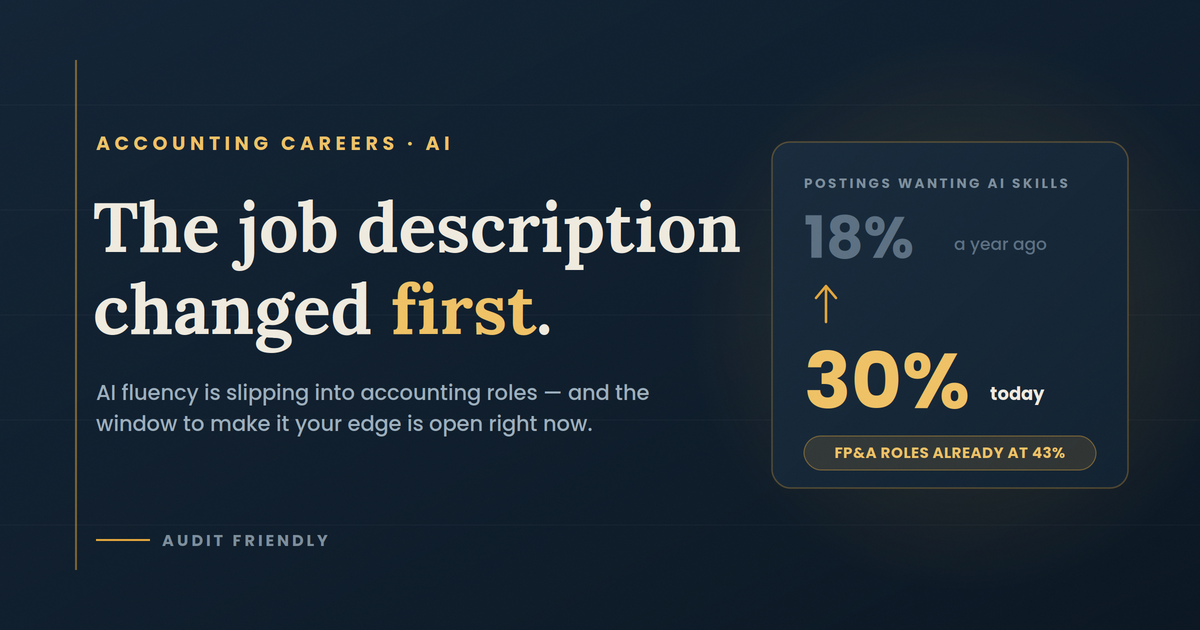
The job descriptions are changing before the job titles do, and that's the part worth paying attention to. Across the accounting and finance roles we track in our database of more than 80,000 postings, the language is shifting quietly - a line about "familiarity with AI tools," a nod to "automation in the close," a requirement to "leverage analytics platforms" that wasn't there a couple of years ago. And it's not just our read: the share of accountant job postings asking for AI skills jumped from 18% to 30% in a single year, the biggest move of any finance function, with FP&A roles out front at 43%. The pay signal is there too - Lightcast, which parses over a billion postings, found that jobs asking for AI skills carry roughly a 28% salary premium. So if you're the experienced accountant who's been meaning to get to this, this is your read on what's actually being asked and what to do about it.
What AI skills are accounting postings actually asking for?
Mostly not what the hype implies, which is a relief. Employers writing these descriptions aren't asking you to train a model or write Python from scratch - they're asking whether you can put existing AI tools to work inside a real finance workflow. That looks like comfort with the AI features already baked into your ERP and close software, the judgment to use a large-language-model assistant to draft a reconciliation narrative or a variance commentary and then check it, and enough fluency with analytics tools to pull and shape your own data instead of waiting a week on someone in IT. The bar right now is practical, not technical, and that's the whole opportunity - the skills being screened for are ones you can build on the job you already have, not ones that require going back to school.
Why is this showing up in accounting first, of all places?
Because accounting is full of the exact work AI is good at right now - rules-based, repetitive, document-heavy, the reconciliations and tie-outs and first-pass commentary that eat the calendar before any judgment gets applied. That's the same pattern we keep coming back to: the boring 80% that comes before the decision is where automation earns its keep, and finance has more of that 80% than almost any other function. Employers can feel it, even when they can't articulate it, so the requirement creeps into the posting as a hedge - they want someone who'll lean into the tooling rather than fight it. If you want the longer argument for why this changes how you should even evaluate software, we made it in the case for asking whether an agent can actually run your accounting software.
How much should you actually trust the AI-skills premium?
Some, but hold it loosely, because a 28% premium across the whole economy is not a promise that your next close-the-books job pays 28% more for tossing "ChatGPT" on your resume. The premium is real and it's measurable, and it's also concentrated in roles where the AI skill is genuinely load-bearing, not decorative. For accountants the honest version is narrower and more durable: the people who learn to run the tooling well, who can show they cut days off a close or turned a week of data gathering into an afternoon, are going to out-earn the people who can't, and that gap widens every year. So chase the capability, not the keyword. The keyword gets you screened in; the capability gets you paid.
What does this mean for the 30-to-45 accountant who's been putting it off?
It means the window where this is a differentiator is open right now and won't stay open, which is genuinely good news if you move. You've got the thing the new graduates don't - you understand the work, the controls, the way a real close actually breaks - and that domain knowledge is exactly what makes AI useful instead of dangerous in finance. A junior pointing an LLM at a ledger has no idea when the output is wrong; you do. So the move is to pair what you already know with the tooling, deliberately, on one workflow at a time. Pick the part of your month that you hate most, the AP grind or the data gathering for the flux, and put AI on that first. The point isn't to become technical, it's to become the accountant who ships faster than the one sitting next to you.
What I'd do
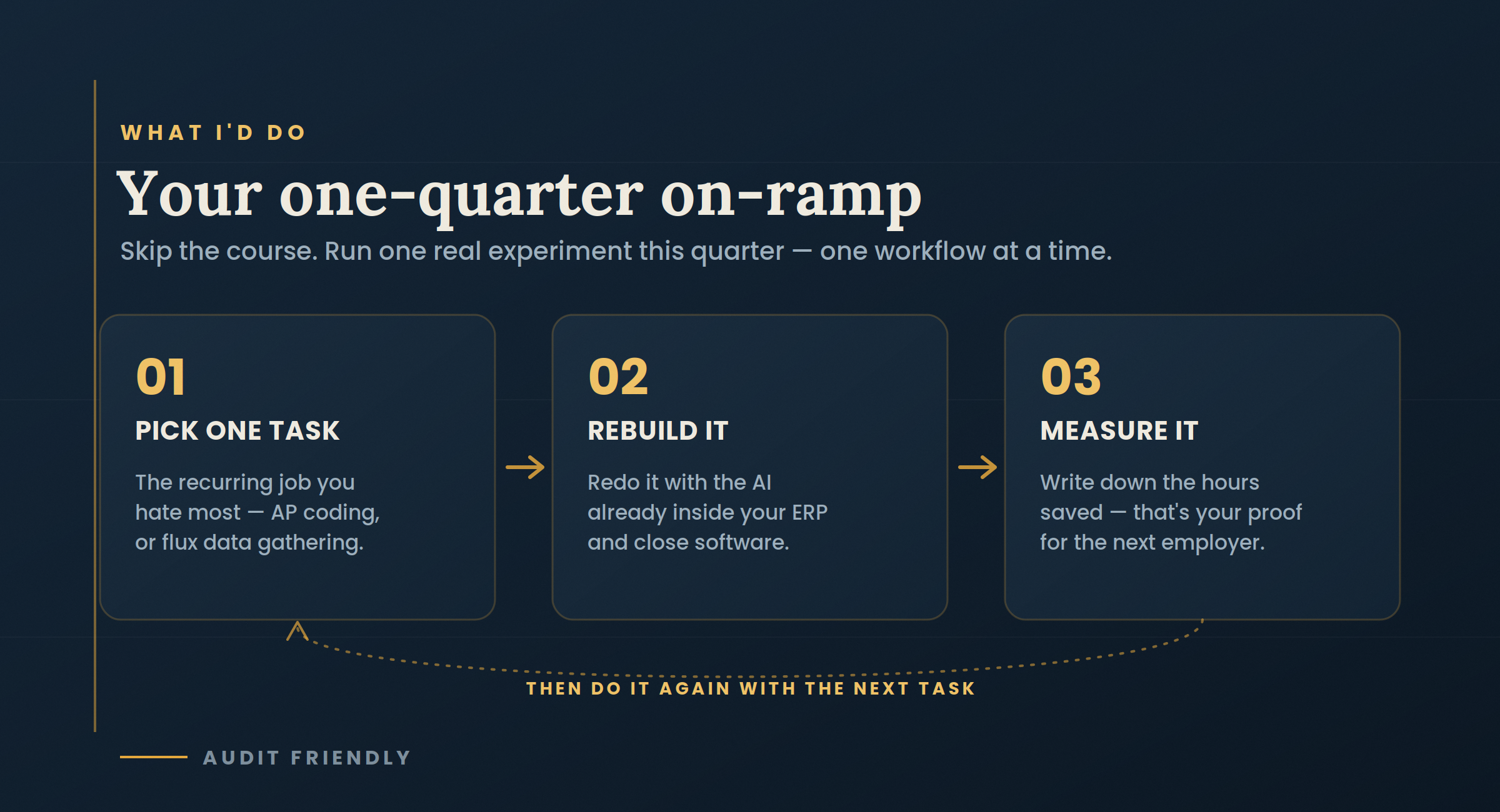
If I were an experienced accountant reading the writing on the wall, I'd stop treating this as a someday project and run one real experiment this quarter. Take a single recurring task - reconciliations, AP coding, the first draft of variance commentary - and rebuild it with whatever AI tooling your stack already has, measure how much time it actually saves, and write down what you learned. Then do it again with the next task. That's it - that's the whole on-ramp, and it doubles as the exact evidence you put in front of a hiring manager when one of these postings lands. While you're at it, it's worth knowing which software actually runs finance teams right now, because the AI features worth learning live inside the platforms employers already use - you can see how they shake out across our directory of accounting and finance software. And if you're job-hunting while you build the skill, the remote accounting board is a fast way to see which employers are already writing AI into the description.
Frequently asked questions
Do accounting jobs really require AI skills now?
Increasingly, yes. The share of accountant job postings asking for AI skills climbed from 18% to 30% in a single year - the biggest jump of any finance function - and it's running even higher in FP&A. It's often still framed as preferred rather than required, but that line is moving fast toward the core requirements.
What AI skills do accountants need?
Practical ones, not technical ones: using the AI features inside your ERP and close software, using an LLM assistant to draft and then verify narratives and commentary, and enough analytics fluency to pull and shape your own data. You don't need to code.
Do AI skills actually pay more in accounting?
There's a measurable premium - Lightcast found roughly a 28% salary premium for AI-skill postings economy-wide. For accountants the durable version is narrower: people who genuinely run the tooling well and can show time saved will out-earn those who can't.
Will AI replace accountants?
Not the judgment-heavy work - risk assessment, materiality calls, the opinion, the controls. AI is strong on the rules-based, repetitive prep that comes before the judgment. The accountants who pair their domain knowledge with the tooling are the ones who pull ahead.
How do I start learning AI for accounting work?
Pick one recurring task you dislike, rebuild it with the AI tooling already in your stack, measure the time saved, and repeat with the next task. One workflow at a time beats any course, and it doubles as proof for your next employer.
The postings are the early signal, and they're pointing the same direction the whole profession is heading. The accountants who treat AI as something to build with - one workflow at a time, starting this quarter - are going to be the ones writing their own ticket while everyone else is still arguing about it. So go build something.


