Rolling Reconciliations Were Always the Answer. AI Finally Makes Them Worth It.
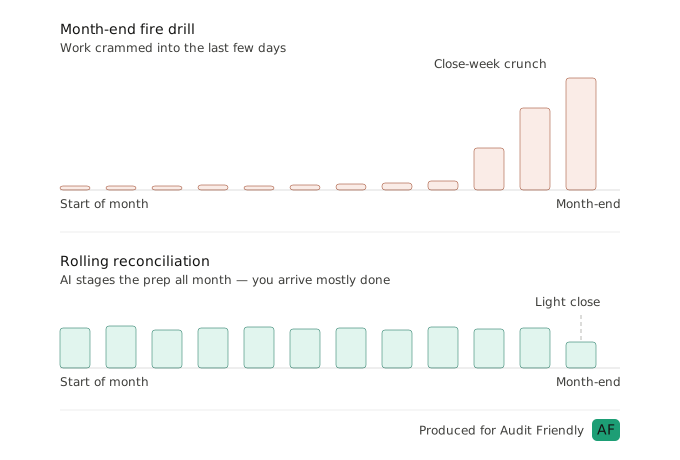
Lorem ipsum dolor sit amet, consectetur adipiscing elit. Donec rhoncus neque sed nibh sagittis, fringilla porttitor ipsum tristique. Nulla interdum ex et nisi vehicula, id laoreet nisl ultricies. Phasellus vitae magna ac lacus dictum tincidunt. Sed iaculis metus nec viverra pulvinar. Etiam id nisi eu turpis mattis imperdiet ac ac tortor. Aliquam at ipsum dui. Etiam pharetra consequat massa. Aenean nec lectus sit amet metus pharetra dapibus. Pellentesque interdum ex eget nisi fringilla, id semper erat rhoncus. Suspendisse lectus leo, malesuada pharetra commodo a, sollicitudin eu erat. Nullam justo nisl, tincidunt vel auctor id, luctus a tellus.
Aliquam convallis condimentum volutpat
Pellentesque sollicitudin mauris sit amet enim volutpat, at faucibus sem laoreet. Morbi egestas ex non orci interdum, ut elementum orci faucibus. Maecenas et sem convallis erat dignissim facilisis. Quisque purus sapien, pellentesque euismod varius id, fermentum nec nibh. Integer commodo dignissim ipsum, ac accumsan metus fringilla sit amet. Aenean aliquam sem finibus tempor venenatis. Aliquam ac facilisis turpis, eu posuere ipsum.

In nisi dui, ultricies sit amet gravida vel, ullamcorper vel mauris. Aliquam nec sapien odio. Sed vitae suscipit felis. Nullam semper blandit lectus, eu finibus urna fermentum et. Aliquam vehicula ligula nibh, non efficitur massa iaculis et. Vestibulum vitae euismod odio, non maximus nulla. Sed viverra porta enim ac interdum. Maecenas auctor tristique auctor. Nullam et neque nec tortor malesuada ullamcorper. Pellentesque ac fringilla ante, non convallis est. Proin velit augue, rutrum vitae ipsum vel, malesuada dictum urna. Nunc vulputate sit amet odio vitae ullamcorper. Nullam suscipit ornare eros, et viverra sapien hendrerit quis. Donec odio eros, ultricies a risus quis, efficitur elementum turpis. Etiam interdum diam quis turpis ultricies.
Sed euismod quam vestibulum
Sed non sapien eros. Duis fringilla fringilla lectus sit amet aliquam. Aliquam erat volutpat. Vivamus molestie, felis rutrum luctus pulvinar, libero metus eleifend mauris, semper malesuada ante eros vitae eros. Phasellus vitae dolor faucibus, laoreet lectus quis, placerat nisi. Nam ornare nulla id est aliquet, quis fringilla neque congue. Duis facilisis sed massa vel bibendum. Curabitur sollicitudin tristique commodo. Vivamus facilisis venenatis nibh. Integer placerat elementum felis, id consequat lorem consectetur a. Duis laoreet sit amet nisl in eleifend. Interdum et malesuada fames ac ante ipsum primis in faucibus.
Proin eros lacus, pellentesque sed vehicula a, luctus non nibh. Nulla diam sem, posuere ac odio varius, ultrices tristique nibh. Morbi dictum scelerisque convallis. Praesent faucibus lorem lacus, id luctus justo feugiat et. Curabitur eget tellus non nisi interdum blandit. Maecenas pulvinar est sed ex elementum, ac commodo diam bibendum. Nulla auctor dolor felis, sit amet euismod ante eleifend non. Donec id neque magna.
Rolling reconciliations have been a known best practice for years and almost nobody actually does them, because doing them by hand just takes the month-end pain and smears it across the whole damn month. So everyone keeps choosing the fire drill instead, and honestly I get it - the manual version really wasn't worth the trouble.
What's different now is that the grunt work underneath the close, the part that made rolling recons too expensive to bother with, is exactly the stuff AI handles well today. So I want to walk through what the close actually looks like right now, why it still eats your month, and where this is heading - because the data we're sitting on tells a more interesting story than the usual "AI is coming for accountants" noise.
The honest version is pretty simple. AI is genuinely good at the prep now - pulling support, matching transactions, rebuilding the same schedules you built last month - so it gets you most of the way through a reconciliation before you've even sat down. What's left is the judgment: the weird items, the calls that need an actual accountant. The close doesn't go away, and neither do you. The grind does.
The close is still the entire job
People love to talk about how accounting is changing, but here's something concrete from our own data. We track just about every accounting and finance posting we can find - more than 80,000 in the last 90 days alone - and when you narrow to the senior roles that own the books (controllers, accounting managers, senior accountants, assistant controllers), about 73% of them explicitly call out month-end close or reconciliation work. That's roughly 8,650 out of 11,800 postings naming the close as a core responsibility.
So no, the close isn't some legacy task that's quietly going away. It's still the spine of the job, and employers are still hiring specifically for the people who can run it. If you want to see how often it shows up in live listings, it's all over our accounting job board right now. Getting faster and sharper at the close isn't a nice-to-have, it's the thing you actually get paid for.
So why does month-end still feel like hell?
Because most of the misery isn't the judgment work, it's the setup. Pulling the support, tying out the subledger, chasing the one number that won't reconcile, rebuilding the same workpapers you rebuilt 30 days ago and will rebuild again in 30 more. It's repetitive, it's deadline-driven, and it's the reason close week wrecks your sleep.
The benchmarks back this up. APQC's open-standards data, drawn from more than 2,000 organizations, puts the median monthly close at around 6.4 calendar days, with the slowest quarter of companies still grinding past ten. And a 2025 survey covered by CFO.com found that half of finance teams still take six or more business days to close, with cash reconciliations alone eating 20 to 50 hours a month. For decades the answer to all that was just "work more hours in a tighter window." Throw bodies at it, order dinner in, push through. That was the whole playbook, and it sucked.
Rolling reconciliations, and why nobody bothered
Rolling reconciliations - reconciling continuously through the month instead of cramming it into the last few days - have been the textbook fix forever. The big platforms like BlackLine built an entire category around the idea and called it continuous accounting. The logic is airtight: spread the work out, hit period-end already mostly done, stop living in the fire drill. Teams that run preliminary reconciliations around day 25 to 28 of the month routinely walk into close with 30 to 40% of the work already finished.
So why doesn't everyone do it? Execution. Doing recons continuously by hand doesn't remove the work, it just means you're doing the annoying parts more often. So the best practice stayed mostly theoretical. Everyone nodded along in the conference session and went right back to the month-end scramble.
This is the part AI actually changes. When a tool can pull the support, match the transactions, and draft a first-pass reconciliation on a random Tuesday in the middle of the month, rolling becomes nearly free. You're not adding work, you're reviewing what got staged for you. The 80% that used to make continuous accounting not worth the effort is exactly the 80% AI is good at, so the textbook answer finally became the easy answer.
The weird part: the job market hasn't caught up
Here's where it gets interesting, and a little frustrating. For all the noise about AI eating accounting, the actual job postings barely mention it. Across those same 80,000+ postings, only about 1 in 6 (16%) mention automation at all, and fewer than 1 in 10 mention AI directly. That automation number has crept up over the past six months, from roughly 14% to 16% - so it's moving, but slowly, and off a low base.
Sit with that for a second. The tools to gut the worst part of the close exist right now, and five out of six employers aren't even asking for them yet. The market is slow. Which, if you're paying attention, is a gift - but a closing one. The accountant who shows up already knowing how to wire up a rolling rec with AI is solving a problem most hiring managers haven't finished naming. That's how you stick out like a sore thumb, in the good way. And that 14-to-16% creep tells you the window won't stay open forever.
I say this constantly and I'll say it here too: the single best move you can make right now is to just build something. Anything. The people pulling ahead in this profession aren't the ones with the strongest opinions about AI, they're the ones who opened the tool and tried. It tracks with what the surveys keep finding, too - one widely cited Dext survey found 39% of accountants spend over half their day on manual work. That's a lot of hours sitting right there waiting to be handed off.
Where I'd start if I were you
Pick one account. Something with a clean, repetitive reconciliation you know cold - a bank account, a prepaid schedule, an accrual you rebuild every month. Wire up a rolling rec on just that one thing with whatever AI tool you've got access to, and watch how far it gets you before it needs your brain. You'll learn more from that one build than from a month of reading about it, and you'll probably come away a little pissed at how much of your life you've handed to prep work all these years.
Then do the next account. That's the whole game - not some big transformation project, just steadily handing the boring 80% to the machine so you can spend your time on the part that actually needed you in the first place. And if you're weighing a move while you're at it, it's worth knowing what the close-heavy roles actually pay - our salary insights break it down by role, and if you're prepping for interviews, our interview prep tool is built for exactly these conversations.
Frequently asked questions
Does AI replace the month-end close?
No. AI handles the preparation work - pulling support, matching transactions, drafting reconciliations - but the judgment calls, unusual items, and final review still need an accountant. In our data, about 73% of senior accounting roles still list close and reconciliation work as a core responsibility, so the function is very much alive.
What is a rolling reconciliation?
A rolling reconciliation means reconciling accounts continuously throughout the month rather than all at once at period-end. It's the core idea behind continuous accounting. The goal is to reach month-end already mostly closed, instead of cramming the work into a few stressful days.
How much of accounting work is the month-end close?
Based on our analysis of roughly 11,800 senior accounting job postings, about 73% explicitly call out month-end close or reconciliation as a core duty. It remains one of the most consistently demanded skills in accounting hiring.
Are employers asking for AI or automation skills in accounting?
Mostly not yet. Across 80,000+ recent accounting and finance postings in our data, only around 16% mention automation and fewer than 10% mention AI directly. That number is rising, but slowly - which is exactly why building AI skills now sets you apart.
We pulled every internal figure in this piece from our own database of more than 80,000 accounting and finance job postings. Want to see what's hiring in your space right now? Browse the Audit Friendly job board.
.png)

