The 150-Hour Rule Is Finally Cracking. Here's What the New CPA Path Actually Means.
Lorem ipsum dolor sit amet, consectetur adipiscing elit. Donec rhoncus neque sed nibh sagittis, fringilla porttitor ipsum tristique. Nulla interdum ex et nisi vehicula, id laoreet nisl ultricies. Phasellus vitae magna ac lacus dictum tincidunt. Sed iaculis metus nec viverra pulvinar. Etiam id nisi eu turpis mattis imperdiet ac ac tortor. Aliquam at ipsum dui. Etiam pharetra consequat massa. Aenean nec lectus sit amet metus pharetra dapibus. Pellentesque interdum ex eget nisi fringilla, id semper erat rhoncus. Suspendisse lectus leo, malesuada pharetra commodo a, sollicitudin eu erat. Nullam justo nisl, tincidunt vel auctor id, luctus a tellus.
Aliquam convallis condimentum volutpat
Pellentesque sollicitudin mauris sit amet enim volutpat, at faucibus sem laoreet. Morbi egestas ex non orci interdum, ut elementum orci faucibus. Maecenas et sem convallis erat dignissim facilisis. Quisque purus sapien, pellentesque euismod varius id, fermentum nec nibh. Integer commodo dignissim ipsum, ac accumsan metus fringilla sit amet. Aenean aliquam sem finibus tempor venenatis. Aliquam ac facilisis turpis, eu posuere ipsum.

In nisi dui, ultricies sit amet gravida vel, ullamcorper vel mauris. Aliquam nec sapien odio. Sed vitae suscipit felis. Nullam semper blandit lectus, eu finibus urna fermentum et. Aliquam vehicula ligula nibh, non efficitur massa iaculis et. Vestibulum vitae euismod odio, non maximus nulla. Sed viverra porta enim ac interdum. Maecenas auctor tristique auctor. Nullam et neque nec tortor malesuada ullamcorper. Pellentesque ac fringilla ante, non convallis est. Proin velit augue, rutrum vitae ipsum vel, malesuada dictum urna. Nunc vulputate sit amet odio vitae ullamcorper. Nullam suscipit ornare eros, et viverra sapien hendrerit quis. Donec odio eros, ultricies a risus quis, efficitur elementum turpis. Etiam interdum diam quis turpis ultricies.
Sed euismod quam vestibulum
Sed non sapien eros. Duis fringilla fringilla lectus sit amet aliquam. Aliquam erat volutpat. Vivamus molestie, felis rutrum luctus pulvinar, libero metus eleifend mauris, semper malesuada ante eros vitae eros. Phasellus vitae dolor faucibus, laoreet lectus quis, placerat nisi. Nam ornare nulla id est aliquet, quis fringilla neque congue. Duis facilisis sed massa vel bibendum. Curabitur sollicitudin tristique commodo. Vivamus facilisis venenatis nibh. Integer placerat elementum felis, id consequat lorem consectetur a. Duis laoreet sit amet nisl in eleifend. Interdum et malesuada fames ac ante ipsum primis in faucibus.
Proin eros lacus, pellentesque sed vehicula a, luctus non nibh. Nulla diam sem, posuere ac odio varius, ultrices tristique nibh. Morbi dictum scelerisque convallis. Praesent faucibus lorem lacus, id luctus justo feugiat et. Curabitur eget tellus non nisi interdum blandit. Maecenas pulvinar est sed ex elementum, ac commodo diam bibendum. Nulla auctor dolor felis, sit amet euismod ante eleifend non. Donec id neque magna.
For about thirty years, becoming a CPA has meant 150 college credit hours - a full extra year of school beyond a normal bachelor's, with no clear reason it had to be exactly that. It's widely blamed as one of the big reasons the accounting pipeline dried up, and in May 2025 the people who actually set the rules finally did something about it. The AICPA and NASBA approved a new licensure pathway that drops the 150-hour wall entirely. If you've been watching the accountant shortage and wondering when someone would address the obvious bottleneck, this is it.
Here's what actually changed, what's real today versus still in motion, and what it means whether you're trying to get licensed or just trying to hire people who are.
What they actually approved
On May 14, 2025, the boards of the AICPA and NASBA approved model legislation adding a third route to CPA licensure. There are now three official pathways:
- A master's in accounting, plus one year of experience, plus the CPA Exam
- A bachelor's plus 30 extra credits (the old 150-hour route), plus one year of experience, plus the Exam
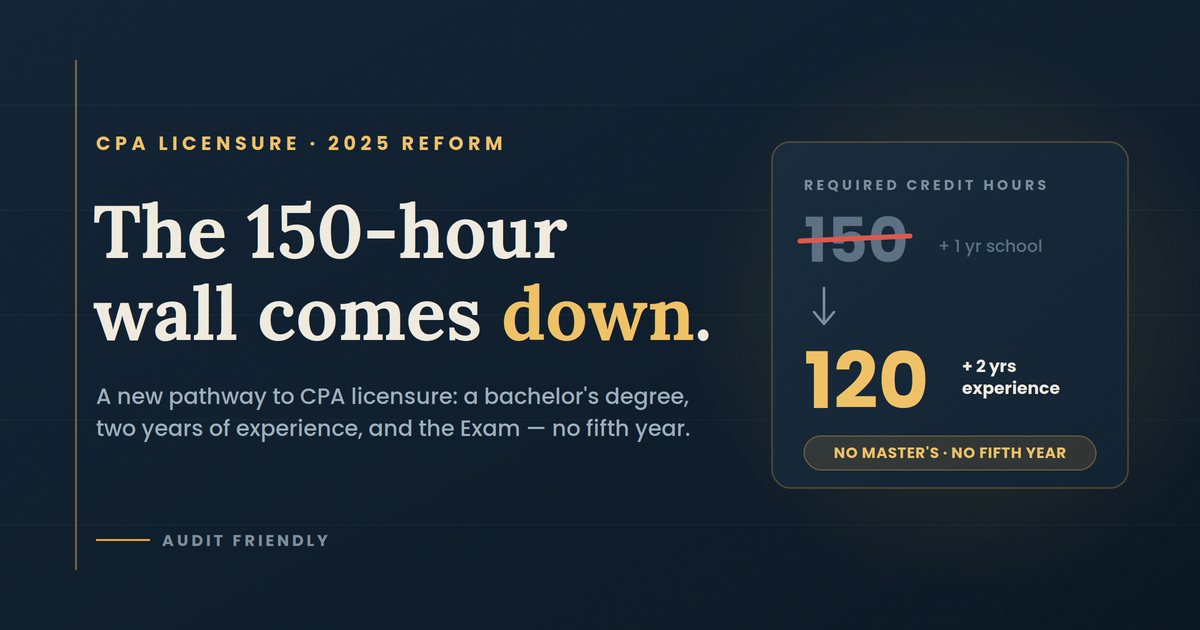
- A bachelor's degree (120 hours), plus two years of experience, plus the Exam - this one's new
That third option is the whole story. You trade the extra year of school for an extra year of actual work experience. For a lot of people that's not just cheaper, it's genuinely better - you learn more doing the job than sitting through 30 more credits of whatever fit your schedule. I said it in our piece on the shortage and I'll say it here: real-world reps beat classroom hours, and the rules are finally catching up to that.
The mobility change nobody's talking about, but should be
Buried in the same announcement is a change that matters just as much: a shift from state-based mobility to individual-based practice privilege. In plain terms, your ability to practice across state lines now travels with you on one license, instead of depending on each state's reciprocity rules lining up. With different states now adopting different licensure paths, that's not a nice-to-have - it's the thing that stops the whole system from fracturing into 50 incompatible rulebooks. Quietly one of the smartest parts of the reform.
What's actually live versus what's still coming
Here's where I'll be straight with you, because a lot of coverage is throwing around state counts that are out of date the week they're published. This is moving fast and unevenly. What's solid: Ohio went first in early 2025, and a batch of states including Virginia and Georgia have laws with the new pathways taking effect January 1, 2026, per Accounting Today's tracking. Beyond that, the number of states on board is climbing month to month, and honestly any specific count I print here would be stale by the time you read it.
So the honest picture: the model legislation exists, the momentum is real and accelerating, but it rolls out state by state. Whether the new path is open to you right now depends entirely on where you're licensed. Check your own state board before you make a plan around it - that's the one piece of homework this article can't do for you.
Why this matters for the shortage
The accountant shortage is brutal and well documented - the profession has shed hundreds of thousands of people, and CPA exam candidates have been falling for years. A big part of that is simple math: the 150-hour rule made the credential cost more time and money than a lot of smart people were willing to spend, especially when finance and tech were waving easier paths to the same paycheck. You don't fix a pipeline problem by keeping the most expensive barrier in place.
Dropping the extra year doesn't magically refill the profession overnight. But it removes one of the few barriers that was entirely self-imposed, and that's a genuinely big deal. For the first time in a long time the trend line on getting licensed is pointing the right way.
What I'd do with this
If you're a student or career-changer who balked at the fifth year, the math just changed - the 120-hour-plus-experience route may be open in your state or coming soon, and it's worth building a plan around. If you're a hiring manager or firm leader, this is a reason for cautious optimism on the talent pipeline, but don't wait around for it to bail you out - the people who can run a close are still scarce today and will be for years. And if you're already a CPA, the mobility change quietly made your license more portable than it was last year. Not bad for a rule everyone said would never move.
Frequently asked questions
Is the 150-hour requirement for CPA licensure going away?
Not entirely - it remains one valid pathway. But as of May 2025, the AICPA and NASBA approved a new option that requires only a bachelor's degree (120 hours) plus two years of experience and passing the CPA Exam, with no 150-hour requirement. States are adopting it individually.
What are the CPA licensure pathways now?
Three: (1) a master's in accounting plus one year of experience plus the Exam, (2) a bachelor's plus 30 additional credits (150 hours total) plus one year of experience plus the Exam, and (3) the new route - a bachelor's (120 hours) plus two years of experience plus the Exam.
When does the new CPA pathway take effect?
It depends on your state. The AICPA and NASBA approved the model legislation in May 2025, but each state must enact it individually. Ohio moved first in early 2025, and several states including Virginia and Georgia have pathways effective January 1, 2026. Check your state board for its specific status.
Does the new pathway change CPA mobility across states?
Yes. The reform shifts from state-based mobility to individual-based practice privilege, meaning a CPA can practice across state lines on a single license rather than relying on state-by-state reciprocity - important now that licensure paths vary by state.
Will this fix the accountant shortage?
It helps but won't fix it alone. The 150-hour rule was a self-imposed barrier that discouraged people from pursuing the credential, so removing it should widen the pipeline over time. But experienced talent remains scarce today, and rebuilding the profession will take years.
We track the accounting hiring market across 80,000+ job postings. See what CPA-track and accounting roles are hiring right now on the Audit Friendly job board, or check what they pay with our salary insights.