Most Accounting Jobs Don't Require a CPA - the Ones That Do Pay For It

Lorem ipsum dolor sit amet, consectetur adipiscing elit. Donec rhoncus neque sed nibh sagittis, fringilla porttitor ipsum tristique. Nulla interdum ex et nisi vehicula, id laoreet nisl ultricies. Phasellus vitae magna ac lacus dictum tincidunt. Sed iaculis metus nec viverra pulvinar. Etiam id nisi eu turpis mattis imperdiet ac ac tortor. Aliquam at ipsum dui. Etiam pharetra consequat massa. Aenean nec lectus sit amet metus pharetra dapibus. Pellentesque interdum ex eget nisi fringilla, id semper erat rhoncus. Suspendisse lectus leo, malesuada pharetra commodo a, sollicitudin eu erat. Nullam justo nisl, tincidunt vel auctor id, luctus a tellus.
Aliquam convallis condimentum volutpat
Pellentesque sollicitudin mauris sit amet enim volutpat, at faucibus sem laoreet. Morbi egestas ex non orci interdum, ut elementum orci faucibus. Maecenas et sem convallis erat dignissim facilisis. Quisque purus sapien, pellentesque euismod varius id, fermentum nec nibh. Integer commodo dignissim ipsum, ac accumsan metus fringilla sit amet. Aenean aliquam sem finibus tempor venenatis. Aliquam ac facilisis turpis, eu posuere ipsum.

In nisi dui, ultricies sit amet gravida vel, ullamcorper vel mauris. Aliquam nec sapien odio. Sed vitae suscipit felis. Nullam semper blandit lectus, eu finibus urna fermentum et. Aliquam vehicula ligula nibh, non efficitur massa iaculis et. Vestibulum vitae euismod odio, non maximus nulla. Sed viverra porta enim ac interdum. Maecenas auctor tristique auctor. Nullam et neque nec tortor malesuada ullamcorper. Pellentesque ac fringilla ante, non convallis est. Proin velit augue, rutrum vitae ipsum vel, malesuada dictum urna. Nunc vulputate sit amet odio vitae ullamcorper. Nullam suscipit ornare eros, et viverra sapien hendrerit quis. Donec odio eros, ultricies a risus quis, efficitur elementum turpis. Etiam interdum diam quis turpis ultricies.
Sed euismod quam vestibulum
Sed non sapien eros. Duis fringilla fringilla lectus sit amet aliquam. Aliquam erat volutpat. Vivamus molestie, felis rutrum luctus pulvinar, libero metus eleifend mauris, semper malesuada ante eros vitae eros. Phasellus vitae dolor faucibus, laoreet lectus quis, placerat nisi. Nam ornare nulla id est aliquet, quis fringilla neque congue. Duis facilisis sed massa vel bibendum. Curabitur sollicitudin tristique commodo. Vivamus facilisis venenatis nibh. Integer placerat elementum felis, id consequat lorem consectetur a. Duis laoreet sit amet nisl in eleifend. Interdum et malesuada fames ac ante ipsum primis in faucibus.
Proin eros lacus, pellentesque sed vehicula a, luctus non nibh. Nulla diam sem, posuere ac odio varius, ultrices tristique nibh. Morbi dictum scelerisque convallis. Praesent faucibus lorem lacus, id luctus justo feugiat et. Curabitur eget tellus non nisi interdum blandit. Maecenas pulvinar est sed ex elementum, ac commodo diam bibendum. Nulla auctor dolor felis, sit amet euismod ante eleifend non. Donec id neque magna.
Most of the accounting jobs you'll scroll past today will hire you without a CPA, and I think a lot of good accountants quietly carry years of feeling behind over a credential that a big share of the roles they'd happily take tomorrow list as "preferred" anyway. Across the roughly 80,000 accounting and finance postings we track at Audit Friendly, current through June 2026, the pattern is consistent enough that it's worth saying plainly: the hard CPA requirement lives at the top of the stack, not the bottom. It clusters around controller, audit manager, technical-accounting and SEC-reporting roles, and anything with "CPA" sitting right there in the job title. The staff and senior listings underneath - the bulk of the market by volume - mostly treat it as a bonus, a tiebreaker, a thing that's nice to have.
So the credential matters, and the credential is also genuinely optional for a huge stretch of a career. Both of those are true at once, and holding them together is the only honest way to give anyone advice about it.
Where does the CPA requirement actually show up?
It tracks seniority and signature authority almost perfectly. The roles that legally need a licensed signer or that report to people who do - external audit beyond the associate level, controller and assistant-controller seats, technical accounting, anything writing the numbers that go in an SEC filing - those put "CPA required" in hard language and mean it. The roles that don't carry that exposure - staff accountant, senior accountant, most FP&A, cost and project accounting, a lot of industry general-ledger work - overwhelmingly list the CPA as preferred, and they'll hire the candidate who can clearly do the work over the candidate who can't but has the letters.
Tax is its own animal. A signing tax preparer at a firm leans hard on the credential, but plenty of corporate and operational tax roles will take experience and an EA instead, which is part of why remote tax work has stayed so open - we got into that in our piece on how remote tax accountant jobs reward the credential without strictly gating on it. The shape repeats everywhere once you look for it: the deeper the regulatory exposure, the harder the requirement.
What is the CPA actually worth in dollars?
Real money, and it compounds, which is the part people underestimate. The AICPA and the salary surveys that lean on its data generally put CPAs somewhere around 10% to 15% ahead of comparable non-credentialed accountants, and that gap doesn't stay flat - it widens as you climb, because the credential is what unlocks the senior and controller seats where the pay curve actually bends upward. Against a national median of $81,680 for accountants and auditors as of May 2024, a low-double-digit percentage is a few thousand dollars a year early on, and it turns into a much bigger spread by the time you're choosing between a senior-manager industry role and a controllership, because one of those doors basically won't open without the license.
The honest caveat is that the premium isn't evenly distributed. If you're going to spend a career in cost accounting at a manufacturer, or you've found a lane in operational finance where nobody's ever going to ask for it, that 10-to-15% is theoretical for you and the time you'd sink into the exam might pay off better invested somewhere else. The credential pays when the path you want runs through the roles that demand it. It pays a hell of a lot less when it doesn't.
The 150-hour wrinkle that's finally loosening
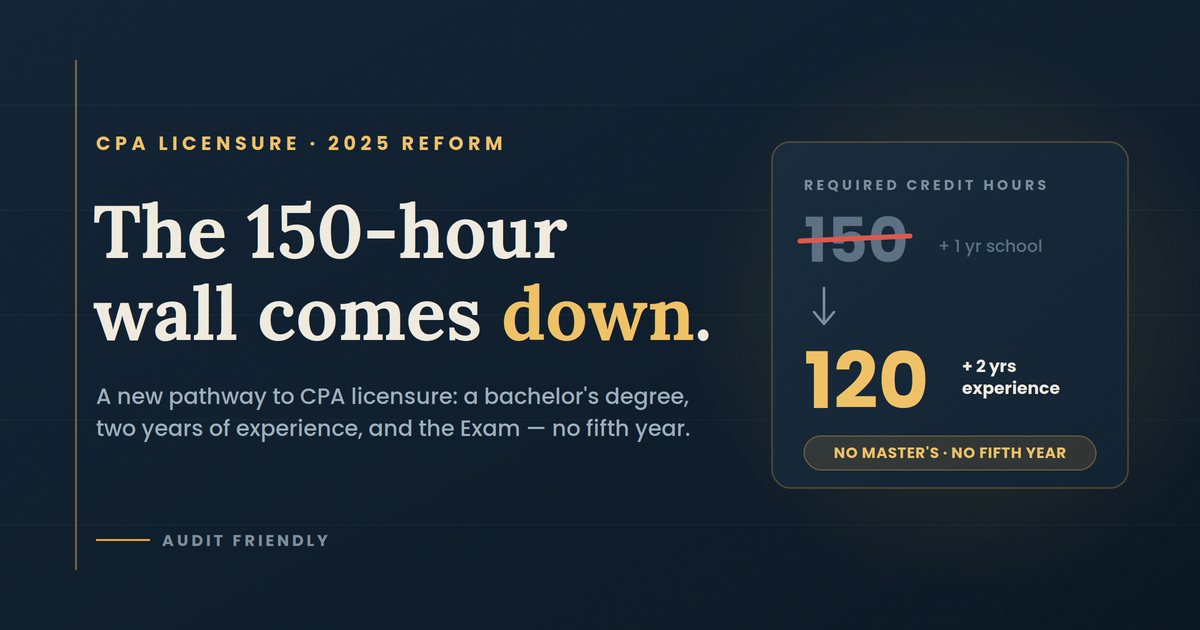
Part of why so many capable accountants skip the CPA has nothing to do with the exam and everything to do with the 150-hour education requirement - the extra year of credits beyond a bachelor's that turned licensure into a genuine pain in the ass of time and money. That barrier is the thing that's actually shifting right now, with states opening up alternative pathways that swap some of those credit hours for experience, and it changes the math for anyone who looked at the old requirement and walked away. I dug into what the new pathways mean in the breakdown of the 150-hour rule cracking, and the short version is that the cost side of this decision is dropping for a lot of people who'd written the credential off.
When chasing the CPA is worth it, and when it isn't
Chase it if you want to end up a controller, a CFO, a partner, or anything in external audit past your first couple of years, because for those the license is the entry ticket and waiting only delays the pay bump. Chase it if you're early and unsure, too, because optionality is worth a lot when you don't yet know which door you'll want, and the credential keeps every door open.
Hold off, or skip it, if you've already built a real lane in a role that doesn't ask for it and you genuinely don't want the ones that do - some of the best operational accountants I've come across never bothered, and they're doing fine because they're undeniably good at the actual work. The credential is a strong default, not a moral obligation, and the idea that a thirty-five-year-old has "failed" by not having one is bullshit usually pushed by someone selling exam prep.
What I'd do
If you're in your twenties and on the fence, get it - the new pathways are cutting the cost of entry and the optionality is worth more than the hassle. If you're mid-career and weighing it, get specific instead of guilty: pull up the actual job titles you want to hold in five years and read what they require, not what LinkedIn shame-posts imply. If those roles say "required," the decision's made for you. If they say "preferred," you've got room to weigh the exam against deepening a specialty that's already paying. And whichever way you go, watch how the requirement language itself is moving - we're tracking it across the postings in real time, and you can see what's actually being asked for right now on the job board, or size up the firms doing the hiring through the accounting firms directory.
Frequently asked questions
Do you need a CPA to work in accounting?
No, not for most roles. Staff accountant, senior accountant, most FP&A, cost accounting and a large share of industry general-ledger work hire without it and often list the CPA as preferred rather than required, per Audit Friendly data, June 2026. You need the license to sign audit and attest work and to move cleanly into controller, technical-accounting and senior external-audit roles.
How much more do CPAs earn?
Roughly 10% to 15% more than comparable non-credentialed accountants according to AICPA-cited surveys, and the gap tends to widen with seniority because the license unlocks the higher-paying controller and partner-track roles. Against the BLS national median of $81,680 for accountants and auditors, that premium starts modest and compounds over a career.
Is the CPA worth it if I work in industry, not public accounting?
It depends on where you're headed. If you want to reach controller, VP of finance or CFO, yes - those seats expect it. If you've built a durable lane in operational or cost accounting that doesn't ask for it and you don't want the roles that do, the premium is largely theoretical for you and your time might pay off better elsewhere.
What is the 150-hour rule and is it changing?
It's the requirement for 150 college credit hours - about a year beyond a standard bachelor's - to get licensed, and it's long been a major reason capable people skip the CPA. It's changing now, with states rolling out alternative pathways that substitute work experience for some of those credit hours, which lowers the cost of entry for a lot of would-be candidates.
Can I become an auditor or tax accountant without a CPA?
Yes, to start. Entry-level audit associates and many corporate and operational tax roles hire without the license, sometimes accepting an EA on the tax side. The credential becomes the gate when you want to sign off on work or move into senior and manager roles where the regulatory exposure makes it non-negotiable.
The useful move here is to stop treating the CPA as a referendum on whether you're a real accountant and start treating it as what it is - a key that opens a specific set of doors, getting cheaper to obtain right as the profession reshapes around it. Read the postings for the job you actually want, do the math honestly, and if the answer is yes, the loosening rules mean there's never been a less painful time to go get it. Then go build something with it.