How to Become an Auditor in Phoenix, No CPA Required to Start

Lorem ipsum dolor sit amet, consectetur adipiscing elit. Donec rhoncus neque sed nibh sagittis, fringilla porttitor ipsum tristique. Nulla interdum ex et nisi vehicula, id laoreet nisl ultricies. Phasellus vitae magna ac lacus dictum tincidunt. Sed iaculis metus nec viverra pulvinar. Etiam id nisi eu turpis mattis imperdiet ac ac tortor. Aliquam at ipsum dui. Etiam pharetra consequat massa. Aenean nec lectus sit amet metus pharetra dapibus. Pellentesque interdum ex eget nisi fringilla, id semper erat rhoncus. Suspendisse lectus leo, malesuada pharetra commodo a, sollicitudin eu erat. Nullam justo nisl, tincidunt vel auctor id, luctus a tellus.
Aliquam convallis condimentum volutpat
Pellentesque sollicitudin mauris sit amet enim volutpat, at faucibus sem laoreet. Morbi egestas ex non orci interdum, ut elementum orci faucibus. Maecenas et sem convallis erat dignissim facilisis. Quisque purus sapien, pellentesque euismod varius id, fermentum nec nibh. Integer commodo dignissim ipsum, ac accumsan metus fringilla sit amet. Aenean aliquam sem finibus tempor venenatis. Aliquam ac facilisis turpis, eu posuere ipsum.

In nisi dui, ultricies sit amet gravida vel, ullamcorper vel mauris. Aliquam nec sapien odio. Sed vitae suscipit felis. Nullam semper blandit lectus, eu finibus urna fermentum et. Aliquam vehicula ligula nibh, non efficitur massa iaculis et. Vestibulum vitae euismod odio, non maximus nulla. Sed viverra porta enim ac interdum. Maecenas auctor tristique auctor. Nullam et neque nec tortor malesuada ullamcorper. Pellentesque ac fringilla ante, non convallis est. Proin velit augue, rutrum vitae ipsum vel, malesuada dictum urna. Nunc vulputate sit amet odio vitae ullamcorper. Nullam suscipit ornare eros, et viverra sapien hendrerit quis. Donec odio eros, ultricies a risus quis, efficitur elementum turpis. Etiam interdum diam quis turpis ultricies.
Sed euismod quam vestibulum
Sed non sapien eros. Duis fringilla fringilla lectus sit amet aliquam. Aliquam erat volutpat. Vivamus molestie, felis rutrum luctus pulvinar, libero metus eleifend mauris, semper malesuada ante eros vitae eros. Phasellus vitae dolor faucibus, laoreet lectus quis, placerat nisi. Nam ornare nulla id est aliquet, quis fringilla neque congue. Duis facilisis sed massa vel bibendum. Curabitur sollicitudin tristique commodo. Vivamus facilisis venenatis nibh. Integer placerat elementum felis, id consequat lorem consectetur a. Duis laoreet sit amet nisl in eleifend. Interdum et malesuada fames ac ante ipsum primis in faucibus.
Proin eros lacus, pellentesque sed vehicula a, luctus non nibh. Nulla diam sem, posuere ac odio varius, ultrices tristique nibh. Morbi dictum scelerisque convallis. Praesent faucibus lorem lacus, id luctus justo feugiat et. Curabitur eget tellus non nisi interdum blandit. Maecenas pulvinar est sed ex elementum, ac commodo diam bibendum. Nulla auctor dolor felis, sit amet euismod ante eleifend non. Donec id neque magna.
You can start working as an auditor in Phoenix without a CPA license already in your pocket, and that surprises almost everyone who's staring down the 150-hour rule like it's a locked door at the start of the profession. The license is what lets you sign the actual audit opinion on someone's financial statements, and there's a whole career's worth of real auditor work underneath that signature that doesn't need it yet. Which is good news, because between the credit-hour math and the exam, the CPA path can feel like it's designed to keep people out rather than let them in, and if that's pissed you off at some point, you're not wrong to feel that way.
What does an auditor actually make in Phoenix?
Across the accountant and auditor postings we're tracking nationally, and pulling in federal wage data specific to the metro, accountants and auditors in the Phoenix-Mesa-Chandler area earn a median of roughly $80,820 a year, with the middle half of earners landing between about $66,340 and $105,640, according to Occupational Employment and Wage Statistics data reported through O*NET OnLine. That's a real range, not a headline number somebody rounded up to sound good, and where you land in it depends almost entirely on whether you're doing staff-level fieldwork or running the engagement. A first-year auditor at a regional firm or an internal audit shop is going to sit toward the bottom of that band, and a senior auditor with a few years and a CPA in progress climbs toward the top pretty fast.
You don't need the CPA to start
Here's the part that gets buried under all the licensure talk: internal auditors, government auditors, and staff or senior associates on an external audit engagement team almost never need a CPA license to get hired or to do the job day to day. What actually requires the license is signing the audit opinion, and for public companies the firm doing that signing also has to be registered with the PCAOB. Everything before that signature, testing controls, pulling samples, tying out balances, writing up findings, is work a non-licensed auditor does constantly. You'll want the CPA eventually, both for the pay bump and because it's the thing that lets you actually run engagements instead of just working them, but treating it as a prerequisite to even applying is a damn shame, and it's the same trap we saw when we wrote about bookkeepers assuming they needed a degree they didn't. Good candidates talk themselves out of applying because of a credential requirement that's actually further down the road than they think.
Arizona just changed the path in, and most people haven't noticed
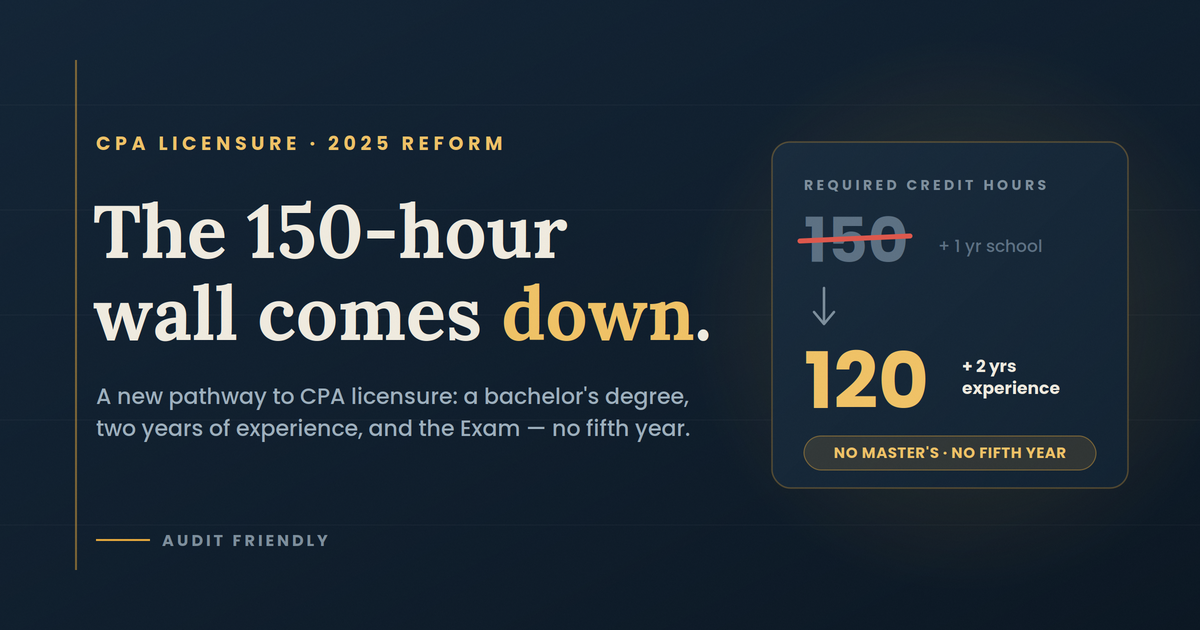
As of today Arizona still runs the traditional rule: 150 semester hours including a bachelor's degree, the four-part CPA exam, and 2,000 hours of supervised accounting experience. We wrote about the national version of this fight in our piece on the 150-hour rule finally cracking, and Arizona is one of the states that actually followed through. Governor Katie Hobbs signed SB1181 in April 2026, and it rewrites the licensure path pretty significantly starting January 1, 2027. Instead of one fixed 150-hour requirement, candidates get three ways in: a bachelor's plus two years of experience, a bachelor's plus 30 extra credit hours and one year of experience, or a postbaccalaureate degree plus one year of experience. The bill also adds individual CPA mobility, so a CPA already licensed elsewhere can practice in Arizona without a separate state license. If you're timing your own path, build around that January 2027 date rather than assuming the old rule is permanent, because Arizona just told you it isn't.
Where the Phoenix auditor jobs actually sit
The Phoenix market isn't a two-firm town. You've got national and regional public accounting firms doing external audit work, which you can browse in our accounting firms directory, a real bench of internal audit roles inside the healthcare systems, homebuilders, and financial services companies that have grown up around the Valley, and government auditor positions at the state and municipal level that almost nobody thinks to check. Internal audit and government roles are worth taking seriously as an entry point, because they'll hire you on your coursework and let you build the 2,000 hours the license eventually wants, all while you're earning a real salary instead of waiting on the credential.
What I'd do
If I were starting from zero in Phoenix, I'd stop treating the CPA as step one and start applying to internal audit and staff auditor roles the moment I had a bachelor's in accounting or close to it, because that's the fastest way to get paid while you're accumulating both hours and actual judgment. I'd start the exam sections in parallel once I had a job and could study around a real schedule, since the material sticks better once you've seen it in practice. And I'd watch the SB1181 timeline instead of assuming the rules are fixed, because if the 30-extra-credits option ends up cheaper than a full fifth year of school, that's real money you don't have to burn chasing a requirement that's already halfway out the door.
Frequently asked questions
Do you need a CPA to work as an auditor in Phoenix?
No, not to get hired for most auditor roles. You need it to personally sign an audit opinion, and firms auditing public companies must be PCAOB-registered. Internal auditors, government auditors, and staff-level external auditors typically work without one, at least at first.
What's the typical auditor salary in Phoenix?
Accountants and auditors in the Phoenix-Mesa-Chandler metro earn a median of about $80,820 a year, with the middle half falling between roughly $66,340 and $105,640, based on federal wage data reported through O*NET OnLine.
Is Arizona changing its CPA licensure requirements?
Yes. SB1181, signed in April 2026, creates three alternative paths to licensure starting January 1, 2027, replacing the flat 150-hour, 2,000-hour rule with more flexible options and adding CPA mobility for licensees from other states.
What's the fastest way into auditing without a CPA yet?
Internal audit teams, government auditor positions, and staff or senior associate roles at public accounting firms are the most common entry points, and all three let you accumulate the experience hours your eventual license will require.
Should I still get the CPA if I don't need it to start?
Almost always, yes, eventually. It's what lets you sign opinions, run engagements instead of just staffing them, and it still moves the pay needle. It's a "when," not a "day-one requirement," which is a very different decision to make.
The auditor path in Phoenix is more open than the CPA-exam industrial complex makes it look, and it's about to get more open still. We track every one of these roles as they get posted, direct to the employer, no recruiter noise. Check what's open in Phoenix, and go build the experience while the rules are still being written.